
The Hidden Cost of Institutional Amnesia in Remote Teams
Distributed organizations lose critical decision context over time, leading to duplicated work, reversed strategies, and eroded trust.
The Vanishing Context: Why Remote Teams Forget Faster

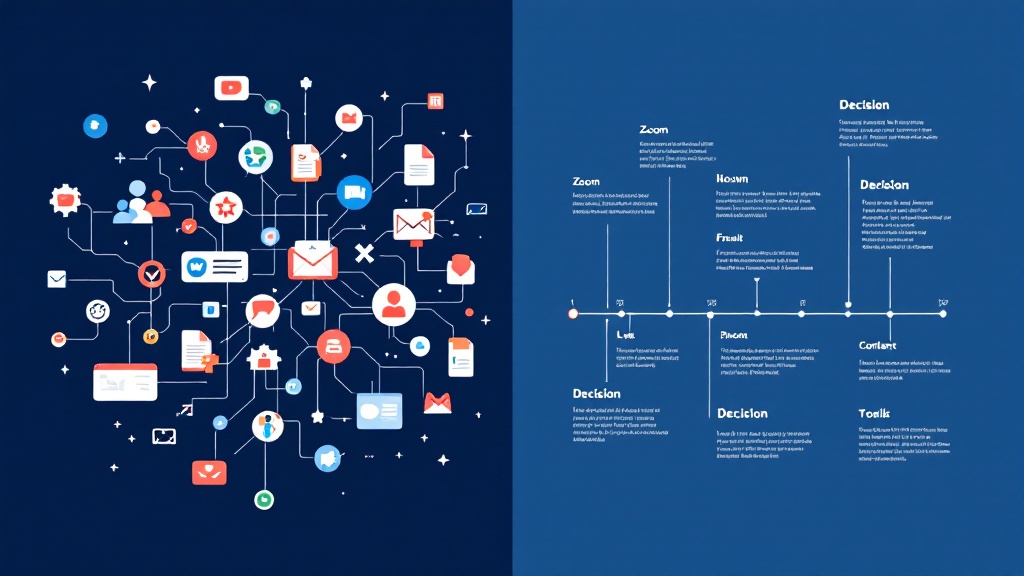
When a team decides to pivot its pricing strategy or choose one vendor over another, the decision itself is just the tip of the iceberg. The real value lies in the context: the alternatives considered, the objections raised, the data that informed the choice, and the people who championed or opposed it. In traditional office environments, this institutional knowledge lived in hallway conversations, whiteboard sessions, and the collective memory of people who sat together daily. But in distributed teams, where decisions scatter across Slack threads, Zoom recordings, email chains, and Jira tickets, context evaporates almost instantly.
Organizational psychology research reveals that remote work fundamentally changes how knowledge management operates within teams. Without physical proximity, the informal knowledge transfer that happens naturally in offices—the quick desk-side explanation, the overheard conversation, the impromptu lunch discussion—simply doesn't occur. Each tool becomes a silo, and each time zone creates a new layer of asynchronous communication that fragments the decision trail. What remains is often just the outcome, stripped of the reasoning that made it sensible at the time.
This phenomenon, which we might call institutional amnesia, isn't merely an inconvenience. It's a compounding organizational debt that grows more expensive with every passing quarter, affecting everything from strategic consistency to team morale.
The Compounding Costs: Measuring What Gets Lost
The financial impact of institutional amnesia manifests in ways that rarely appear on balance sheets but devastate productivity nonetheless. Consider the product manager who spends three hours searching through old Slack channels to understand why the team chose a particular API architecture, only to give up and schedule meetings with five different people to reconstruct the decision. Or the engineering lead who unknowingly proposes reverting to a framework the team explicitly rejected six months earlier, triggering a two-week debate that rehashes arguments already settled. These aren't isolated incidents—they're the daily tax that distributed teams pay for lost context.
Research on knowledge work productivity suggests that information workers spend nearly 20% of their time searching for internal information or tracking down colleagues who can help with specific questions. For remote teams dealing with institutional amnesia, this percentage climbs even higher. But the costs extend beyond wasted hours. When new hires can't access the reasoning behind existing systems, onboarding slows dramatically. When stakeholders can't trace how a decision evolved, trust erodes. When teams unknowingly reverse previous decisions, it signals organizational chaos and damages credibility with customers and partners.
Perhaps most insidiously, institutional amnesia creates a culture where decisions feel arbitrary rather than principled. When people can't see the thread connecting past choices to current strategy, they begin to question leadership judgment, assume political motivations, or simply disengage from decision-making processes altogether. The psychological impact on distributed teams is profound: without shared institutional knowledge, there's no shared institutional identity.
Building Organizational Memory: From Amnesia to Intelligence

The solution to institutional amnesia isn't simply better documentation—it's creating systems that treat decision context as a first-class asset. Forward-thinking distributed teams are implementing what might be called decision memory systems: infrastructure that continuously captures, links, and surfaces the full context around important choices. This means moving beyond static wikis and shared drives toward intelligent systems that understand the relationships between a Slack discussion, the Zoom call that followed, the email thread with legal, and the Jira ticket that tracked implementation.
The technology exists to solve this problem. AI-powered knowledge management tools can now ingest conversations across multiple platforms, extract decisions and their surrounding context, and make that information retrievable through natural language queries. When a team member asks, "Why did we choose vendor X over vendor Y?" the system can return not just a document, but the actual meeting recording, the participants involved, the specific objections raised, and how those concerns were addressed. This transforms institutional knowledge from something that lives in people's heads into a searchable, shareable organizational asset.
The teams that solve institutional amnesia first will gain a decisive advantage. They'll onboard new members faster, make more consistent strategic decisions, and build cultures where every choice is traceable to clear reasoning. For remote work to truly scale beyond the limitations of physical offices, distributed teams must stop treating decision context as ephemeral and start treating it as the institutional knowledge infrastructure it actually is. The question isn't whether your organization suffers from institutional amnesia—it's whether you're ready to cure it.